
Fixed Income Is Back in Focus
Fixed Income Is Back!
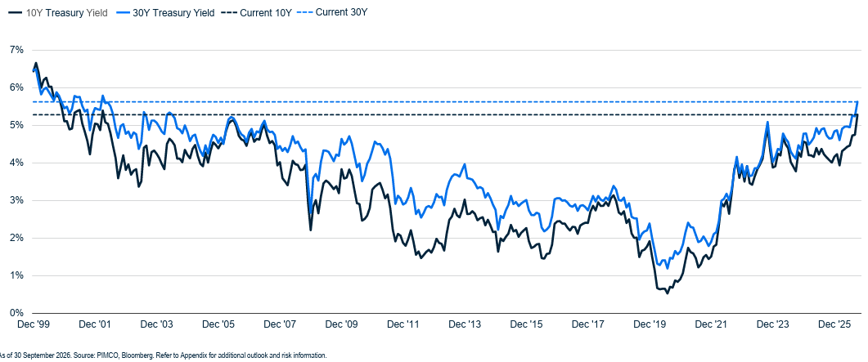
For much of the past decade, bond investors, had to deal with an era of ultra-low interest rates.
Today, that backdrop has changed.
If you have been on the fence about bonds, here is why now is a good time to take a fresh look.
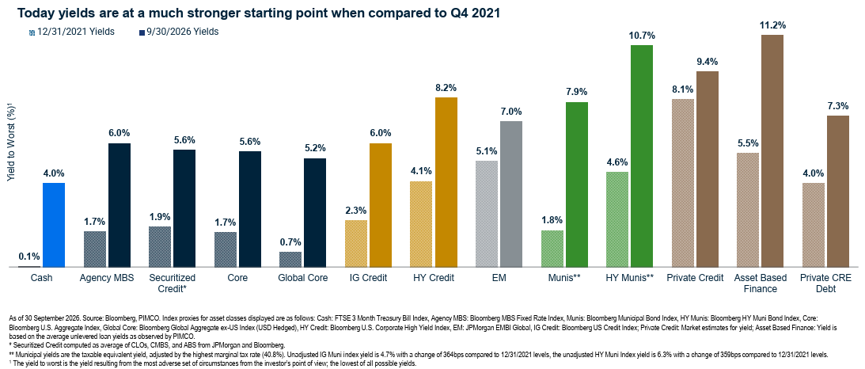
Starting yields
This is important: today investors do not need interest rates to decline to benefit!
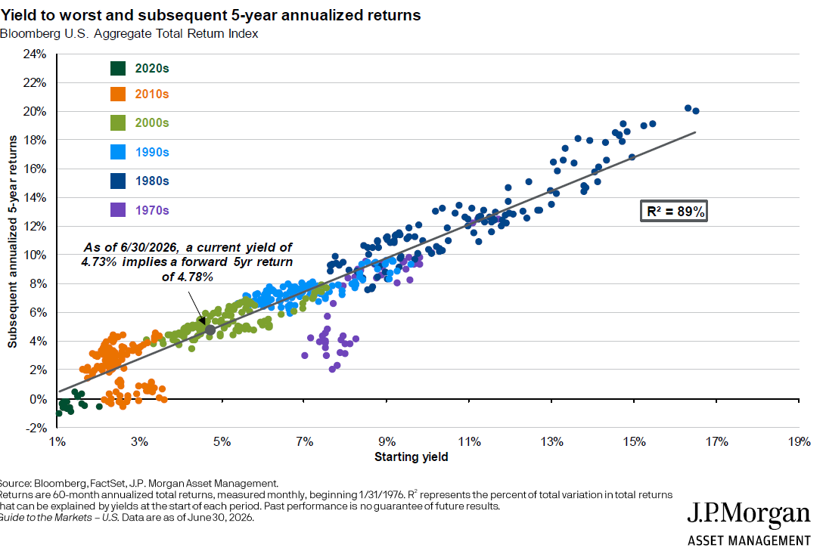
Frequently highlighted in analyses like the J.P. Morgan Guide to the Markets is that starting yields are one of the most reliable predictors of your subsequent 5-year and 10-year annualized returns.
Simply said, when you buy bonds at higher starting yields today, you lock in a powerful structural tailwind that past zero-rate cycles simply could not provide.
A meaningful portion of a bond's potential return comes from the income it generates. And if rates decline, investors may also benefit from rising bond prices. If rates increase, higher income can help cushion the impact of falling prices.
Fixed income yields and forward returns
Think back roughly 10 years ago, when 10-year U.S. Treasury yields hovered near 2%. Investors seeking a reliable 4% or 5% return had to take on significant risk by stretching into junk bonds or volatile equities. Today, with the 10-year Treasury sitting around 5% and corporate sectors offering even higher carry, fixed income can finally do what it was designed to do: generating meaningful income while providing a measure of protection against market volatility.
Municipals for High-Tax Brackets
Municipal bonds, or MUNIs, deserve special attention for investors in higher tax brackets. Interest from most municipal bonds is exempt from federal income taxes and may also be exempt from state and local taxes when investors purchase qualifying bonds issued in their state of residence.
This tax advantage can make MUNIs more opportunistic than their stated yields initially suggest. For example, consider a municipal bond yielding 3.27%. For an investor in the 37% federal income tax bracket, the tax-equivalent yield is approximately 5.19%.
Here is the math: Tax-equivalent yield = Municipal bond yield ÷ (1 − Tax rate)
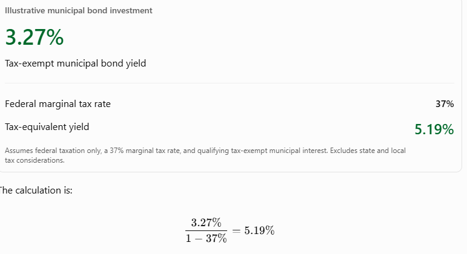
In other words, an investor would need to earn approximately 5.19% on a fully taxable bond to match the after-tax income of the municipal bond, assuming federal taxes only.
This example illustrates why municipal bonds can be particularly valuable for high-income households. The actual benefit will depend on an investor's tax situation, state of residence, and the specific bond.
The Role of Fixed Income in a Portfolio
Bonds play a vital defensive role in a healthy asset allocation. While stocks are typically the primary engine of long-term growth, they also expose investors to significant market volatility.
Fixed income acts as the shock absorber of your portfolio (risk management).
When equity markets stumble, high-quality bonds provide stability, predictable coupon payments (don’t forget these are contractual obligations), and capital preservation. Having a healthy allocation to fixed income means you don't have to sell stocks at a loss when you need cash.
The opportunity is not without risks. Bond prices can decline when interest rates rise, and lower-quality bonds carry additional credit risk. However, as of the writing of this article starting yields may provide investors with an foundation they had in previous decades.
The takeaway
Fixed income should not be viewed simply as a conservative alternative to stocks. It can be a meaningful source of portfolio income, diversification, and potential capital appreciation.
As always, the right approach depends on your investment objectives, time horizon, and tolerance for risk.
The views stated in this letter are not necessarily the opinion of Cetera Wealth Services, LLC and should not be construed directly or indirectly as an offer to buy or sell any securities mentioned herein. Due to volatility within the markets mentioned, opinions are subject to change without notice. Information is based on sources believed to be reliable; however, their accuracy or completeness cannot be guaranteed. Past performance does not guarantee future results. These examples are hypothetical only, and do not represent the actual performance of any particular investments. Investments in securities do not offer a fixed rate of return. Principal, yield and/or share price will fluctuate with changes in market conditions and when sold or redeemed, you may receive more or less than originally invested. Allocation and diversification does not assure a profit or protect against loss in a declining market. The return and principal value of bonds fluctuate with changes in market conditions. If bonds are not held to maturity, they may be worth more or less than their original value. Cetera Wealth Services, LLC exclusively provides investment products and services through its representatives.
Sources:
- PIMCO:4Q 2026 Advisor Playbook
- JP Morgan Asset Management: 3Q 2026 Guide to the Markets