
Why Are Long-Term Interest Rates Rising?
Why Are Long-Term Interest Rates Rising?
Interest rates affect nearly every part of our financial lives. They influence the interest you earn on savings, the rate you pay on a mortgage, and the cost of borrowing for a car or business.
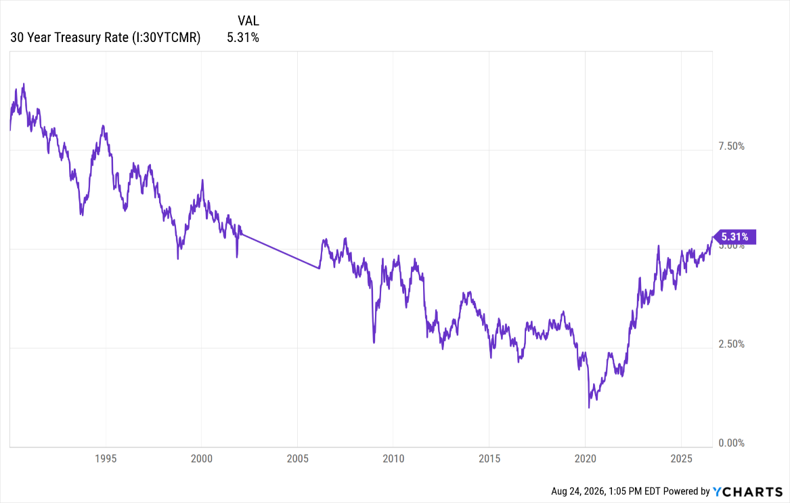
Recently, the long end of the U.S. Treasury market has been under pressure. On August 17, 2026, the 30-year Treasury yield reached 5.31%, its highest level since June 2007.
Why are long-term yields rising?
Several forces are pushing on the bond market at the same time, including inflation, uncertainty about Federal Reserve policy, heavy government and corporate borrowing, and geopolitical risks.
Before looking at those factors, it is important to remember that the Federal Reserve controls short-term monetary policy, but it does not directly set the interest rate on a 10-year or 30-year Treasury bond.
Long-term Treasury yields are determined by the bond market. They reflect investors' expectations for inflation, economic growth, future Federal Reserve policy, government borrowing, and the supply and demand for bonds.
Reason 1: Inflation Expectations Remain Elevated
Inflation affects the purchasing power of your money, from what you spend on groceries and gasoline to what you pay contractors.
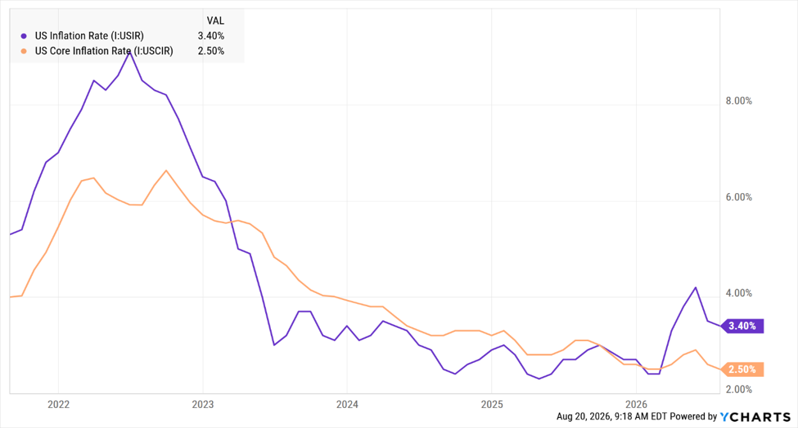
The latest data show that inflation has cooled substantially from its peak, but it has not returned to the Fed 2% objective.

Consumer prices were up 3.4% over the 12 months ending in July 2026, while core CPI, which excludes food and energy, was up 2.5%. Energy prices were particularly strong, rising 14.7% over the year.
Inflation also matters when you lend money, especially for a long time.
When investors lend money for 10, 20, or 30 years, they have to think about what that money will be worth in the future. If inflation remains higher than expected, the purchasing power of the interest and principal payments they eventually receive will be lower.
For example, imagine lending someone $10,000 today and receiving your principal back 10 years from now. If prices rise substantially during that period, the $10,000 you receive at the end of the loan will buy less than $10,000 buys today.
As a result, investors may demand a higher yield as compensation for taking on longer-term inflation risk.
The key issue is not simply today's inflation rate. Long-term Treasury yields reflect expectations for future inflation. If investors believe inflation could remain above the Fed's target for longer than expected, or become less predictable, they may demand greater compensation for holding long-term bonds.
Reason 2: Uncertainty About Fed Policy
The Federal Reserve has a major influence over short-term interest rates.
When the Fed changes its federal funds target range, many short-term borrowing and lending rates tend to move in the same direction.
In 2026, the Federal Reserve has kept its federal funds target range at 3.50%–3.75%. The Fed maintained that range at its January, March, April, June, and July meetings. At the July meeting, three committee members preferred a quarter-point increase.
But the Fed does not directly set the interest rate on a 10-year or 30-year Treasury bond. This is why you can sometimes see mortgage rates or 10-year Treasury yields move even when the Fed has done nothing at its latest meeting. Investors are constantly reassessing the expected path of monetary policy, inflation, and economic growth.
In other words, the bond market is focused not only on where interest rates are today, but also on where investors believe they are headed.
Reason 3: Heavy Government and Corporate Bond Issuance
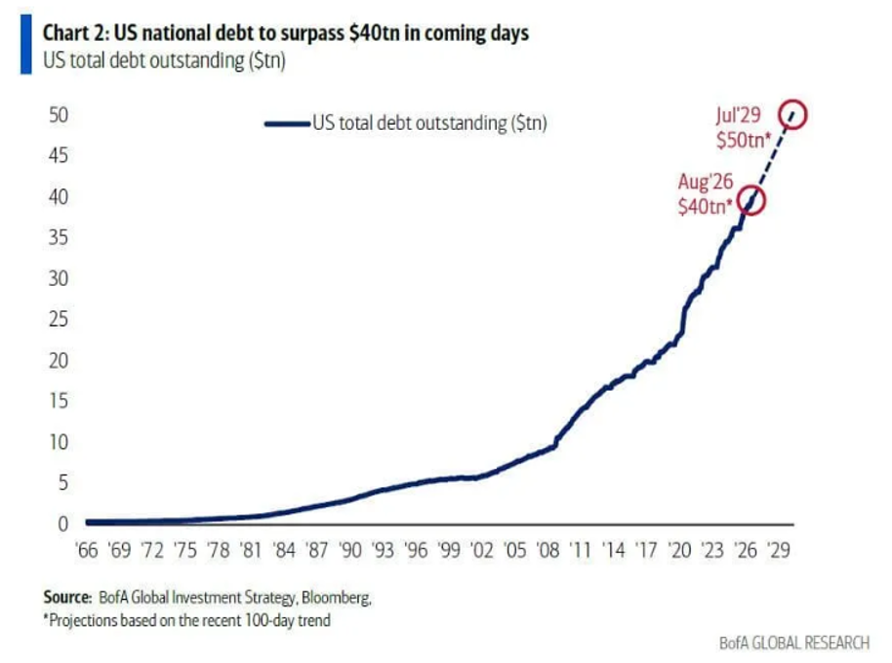
The U.S. government continues to run large budget deficits, requiring the Treasury Department to issue substantial amounts of debt.
The Congressional Budget Office projects that debt held by the public will exceed 100% of GDP in 2026, while gross federal debt is approaching $40 trillion.
To finance government spending, the Treasury must sell bonds to investors.
Large deficits do not automatically cause Treasury yields to rise. What matters is the amount of new debt the market must absorb relative to investor demand, as well as expectations for inflation, economic growth, and monetary policy.
When the supply of new debt increases faster than investor demand, the market may require higher yields to attract buyers.
The same dynamic can occur in the corporate bond market.
Heavy corporate bond issuance, particularly from large technology companies financing data-center and AI infrastructure, is adding to the amount of long-duration debt investors must absorb.
That does not mean corporate issuance is the primary driver of Treasury yields. But it can add to the competition for investor capital.
Overall, large federal deficits and significant corporate borrowing mean investors are being asked to absorb a substantial amount of new debt.
More supply, all else equal, can mean lower bond prices and higher yields.
Reason 4: Geopolitical Risks
Global events can also influence long-term Treasury yields by affecting energy prices, inflation expectations, economic growth, and government spending.
The Russia-Ukraine war and the ongoing conflict between the United States and Iran have contributed to uncertainty surrounding commodities, transportation, and energy supplies.
The recent escalation of tensions between the United States and Iran has also increased concerns about potential disruptions to global energy markets.
Higher energy prices can feed into the broader economy, affecting everything from gasoline to transportation and other goods and services. If investors believe those higher costs could keep inflation elevated, they may demand higher yields on longer-term bonds.
Geopolitical conflicts can also increase government spending and borrowing, potentially adding another source of upward pressure on long-term yields.
The important point is that geopolitical risks do not necessarily cause Treasury yields to rise on their own. Their impact depends on how they affect inflation, economic growth, fiscal policy, and investor expectations.
A New Development: The Treasury Is Buying Back Long-Term Bonds
There is another important development in the Treasury market.
In August 2026, as long-term Treasury yields surged, the U.S. Treasury announced that it would increase certain buyback operations for longer-term Treasury securities.
On August 19, Treasury announced that it would increase the size of certain long-end buybacks from $2 billion to at least $4 billion per operation, covering securities in the 10- to 30-year maturity range. The larger operations are scheduled to begin September 9 and run through November 4.
So what does that mean?
The basic idea is straightforward.
If there are many sellers and not enough buyers, prices can fall. If an additional buyer enters the market and purchases an asset (such as the Treasury), that additional demand can support prices.
The same basic principle applies to Treasury securities.
When the Treasury buys previously issued long-term bonds, it creates additional demand for those securities. Higher bond prices generally mean lower yields because bond prices and yields move in opposite directions.
Therefore, Treasury buybacks can, all else equal, support long-term Treasury prices and put downward pressure on yields.
But it is important not to overstate their purpose. Treasury buybacks are primarily intended to improve liquidity and support the functioning of the Treasury market, rather than directly set or target long-term interest rates.
The buybacks could therefore provide some support to the long end of the Treasury market, but they cannot eliminate the broader forces influencing long-term yields.
We’ll see how effective this plan will be.
What Does This Mean for Investors?
Higher yields are not inherently good or bad. They simply represent a shifting financial landscape.
And there is an important silver lining to higher yields.
For years, investors became accustomed to earning very little on cash and high-quality bonds. When yields rise, new money can earn more income.
That can be particularly useful for retirees who depend on their portfolios to generate income.
For example, if you are purchasing a new Treasury bond, CD, or other high-quality fixed-income investment today, you may be able to lock in a substantially higher yield than was available several years ago.
If you already own a bond paying a relatively low interest rate, its market value generally falls when newly issued bonds offer higher yields. That doesn't necessarily mean you have permanently lost money.
If you hold an individual bond to maturity and the issuer makes all scheduled payments, you generally receive the bond's stated principal at maturity, regardless of changes in its market value along the way.
This is one reason maturity, credit quality and the role of bonds in your overall portfolio matter.
Higher yields can also create challenges for borrowers. Mortgage rates, home equity lines of credit, business loans, and other forms of borrowing can become more expensive when market rates rise.
For households and businesses carrying significant debt, higher borrowing costs can affect cash flow and financial planning.
The Bottom Line
Long-term Treasury yields are elevated because several market and macroeconomic forces are operating at the same time.
Inflation has not fully returned to the Federal Reserve's 2% target, while investors remain uncertain about the future path of monetary policy.
The federal government is running large deficits and issuing substantial amounts of debt. Corporate borrowing, particularly to finance AI infrastructure, is adding to the amount of long-duration debt competing for investor capital.
Geopolitical tensions are creating additional uncertainty around energy prices, inflation, economic growth, and government spending.
The Treasury's decision to increase certain long-term bond buybacks is another important piece of the story. Those purchases can support Treasury prices and, all else equal, push yields lower.
It can be tempting to look at rising yields and conclude that something is wrong with the economy.
That is not necessarily the case.
Higher yields can reflect concerns about inflation, expectations for future interest rates, strong economic growth, heavy government borrowing, changes in the supply and demand for bonds, or the additional compensation investors want for lending money over longer periods.
And the effects are not all negative.
Higher yields can create more attractive income opportunities for savers and bond investors, even while they create challenges for existing bond holdings and borrowers.
For investors approaching or already in retirement, the most important question is therefore not simply: "Where will interest rates go next?"
It is: "Is my portfolio positioned appropriately for a range of interest-rate environments?"
Trying to predict the exact direction of interest rates can be difficult, even for professional investors.
A better approach is to make sure your portfolio's mix of cash, bonds, and stocks reflects your income needs, time horizon, and tolerance for risk.
After all, interest rates will change. A well-designed portfolio should be prepared for that.
The goal is not simply to predict where rates are headed.
It is to make sure your portfolio is positioned to take advantage of higher yields while maintaining an appropriate level of risk.
The opinions are those of the writer, and not the recommendations or responsibility of Cetera Wealth Services, LLC or its representatives. This blog is for educational purposes only, this material does not constitute a recommendation or advice to buy, sell, or hold any security. The return and principal value of bonds fluctuate with changes in market conditions. If bonds are not held to maturity, they may be worth more or less than their original value. All investing involves risk, including the possible loss of principal. There is no assurance that any investment strategy will be successful.
Sources:
- YCharts
- Bank of America Global Research
- Federal Reserve Bank