
Retiring In New Jersey? How to Make the Most of Your Tax Benefits
Let's start with the part nobody argues about:
New Jersey is expensive. We have the highest property taxes in the United States. If you own a home here, you already know this. You get the bill four times a year and you feel it.
What most retirees never see is the other half of the ledger. New Jersey is working hard to keep you here, and it does that through a set of programs that are worth real money. Not theoretical money. Thousands of dollars a year, deposited into your account, if you know the rules and you file on time.
Here is what is available, what people get wrong, and why it changes how you should be taking money out of your accounts.
Social Security is not taxed here. That matters more than you think.
New Jersey does not tax Social Security benefits. Full stop, no income threshold, no phase-out.
The part that gets missed: because Social Security is not New Jersey gross income, it also does not count against the income tests that control every other benefit below. A couple with $60,000 of Social Security and $90,000 of IRA withdrawals looks like a $150,000 household on paper. To New Jersey, they are a $90,000 household. That single distinction can be worth thousands.
The pension exclusion, and the cliff at $150,000
If you are 62 or older (or disabled under Social Security guidelines), New Jersey lets you exclude qualifying pension, annuity, and IRA withdrawal income from state tax. The amount depends on your total New Jersey income, not just your pension income.
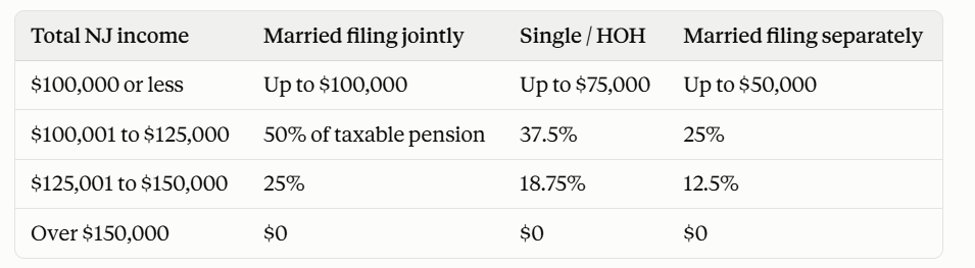
Read that last row again. This is not a phase-out. It is a cliff.
A married couple with $95,000 of total New Jersey income, including $80,000 of pension and IRA income, can exclude the entire $80,000. The same couple at $150,001 excludes nothing. One dollar of income, one extra Roth conversion, one poorly timed capital gain, and the state tax bill jumps by more than a thousand dollars.
That is not a tax question. That is a distribution timing question, and it is the difference between a plan and a guess.
Three property tax programs. One form. One deadline.
Most retirees know one of these exists. Almost nobody knows all three stack.
ANCHOR. Homeowners with 2025 New Jersey income of $150,000 or less receive $1,500. From $150,001 to $250,000, the benefit is $1,000. Renters at $150,000 or less receive $450, or $700 if age 65 or older.
Senior Freeze. This one reimburses you for property tax increases above your base year, so your effective bill stays frozen. You need to be 65 or older, to have owned and lived in the home since December 31, 2022, and to meet the income limits: $168,268 or less in 2024 and $172,475 or less in 2025.
Stay NJ. The newest program, and the biggest. For applicants 65 and older with income of $200,000 or less, Stay NJ tops your total relief up to 50% of your property tax bill, capped at $6,500. It is calculated after ANCHOR and Senior Freeze, so think of it as the layer that fills the gap.
All three are claimed on one application, Form PAS-1. The deadline for the 2025 application is November 2, 2026.
One more thing, because it costs the most when it goes wrong: total property tax relief across all programs cannot exceed the property taxes you actually paid on your home that year.
Four things people get wrong
1. Seniors are not filed automatically. New Jersey files on behalf of most homeowners under 65 and most renters. If you are 65 or older, or receiving Social Security disability, you have to file the PAS-1 yourself. Nobody does it for you. This is where the money actually gets lost.
2. Senior Freeze counts income the state does not otherwise tax. The Senior Freeze income test is not your NJ-1040 number. It includes gross Social Security benefits, tax-exempt interest, capital gains, and gambling winnings. Retirees clear the pension exclusion test and then get denied here, and never understand why.
3. Moving resets your Senior Freeze base year. Downsizing to a smaller home in the same town restarts the clock. You need continuous eligibility from your base year forward. The move that saves you $4,000 in property taxes can cost you a frozen base you spent a decade building.
4. Your IRA is partly tax-free in New Jersey, and almost nobody claims it. New Jersey never gave you a deduction for Traditional IRA contributions the way the federal government did. That means you have New Jersey basis in that account, and a portion of every withdrawal comes out state-tax-free for the rest of your life. It requires tracking, and if nobody tracked it, you are paying tax twice on the same dollars.
Why this is a planning conversation, not a filing conversation
Look at what actually controls these benefits. Not your net worth. Not your portfolio. Your taxable income in a given year, and which accounts that income comes out of.
Pull $30,000 from a Traditional IRA and you may cross the $150,000 line, lose the pension exclusion, shrink your ANCHOR benefit, and reduce your Stay NJ credit, all in the same move. Pull the same $30,000 from a Roth or a brokerage account with a low-basis position sold strategically, and none of that happens.
Same money in your pocket. Very different outcome.
That is the whole point. Where you live determines the rules. Which accounts you draw from determines whether you win under those rules. And the only way to get both right is to
build the plan first and adjust every year as the rules change, because in New Jersey they change often. The Stay NJ income limit was $500,000 last year. It is $200,000 now.
If you are within a few years of retirement in New Jersey, or already there, the November 2 deadline is the immediate action item. The bigger question is whether your withdrawal strategy is being run with any of this in mind.
State of NJ - Department of the Treasury - Division of Taxation - Retirement Income Exclusions
Cetera Wealth Services, LLC exclusively provides investment products and services through its representatives. Although Cetera does not provide tax or legal advice, or supervise tax, accounting or legal services, Cetera representatives may offer these services through their independent outside business. This information is for educational purposely only and is not intended as tax or legal advice.