
The $40 Trillion Question
The $40 Trillion Question
As of early October, America's national debt has exceeded $40 trillion.
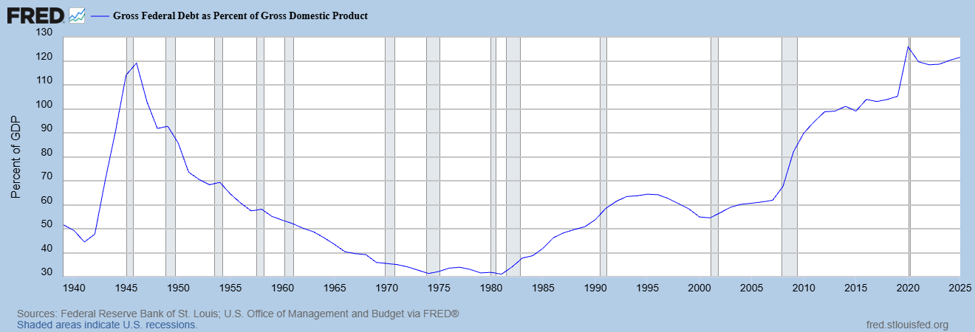
To put that in perspective, the gross federal debt* was roughly half the size of the U.S. economy at the start of this century. Today, federal debt held by the public** stands at 101% of GDP, and the Congressional Budget Office (CBO) projects it will climb to 120% of GDP by 2036, surpassing any level in American history, including the aftermath of World War II.
Should we be worried?
The short answer is: the debt is an important long-term issue, but it is not a reason for investors to panic. Understanding what the number actually represents and how it can affect the economy and financial markets is much more useful than simply watching the debt clock.
First, what exactly is the $40 trillion?
When people talk about America's “$40 trillion in debt,” they are generally referring to government debt, not the amount owed by American households and businesses.
The federal government borrows money by issuing Treasury securities. Investors, including individuals, mutual funds, pension funds, banks, insurance companies, foreign governments and the Federal Reserve purchase those securities.
In other words, government debt is also someone else's financial asset.
That distinction is important. The $40 trillion figure does not mean that Americans collectively have a $40 trillion bill sitting on the kitchen table.
It does, however, represent a significant and growing obligation for the federal government.
Why has the debt grown so much?
There is a simple way to think about it.
The federal government spends money on things such as Social Security, Medicare, national defense, infrastructure and other programs. It also collects revenue, primarily through taxes.
We should note that debt has grown steadily over the past two decades, driven by two major wars, the 2008 financial crisis, and then the enormous COVID-era spending programs.
When the government spends more than it collects, it runs a budget deficit. It then borrows to make up the difference.
Federal budget deficits are large by historical standards: the deficit totaled $1.9 trillion in fiscal year 2026 and is projected to grow to $3.1 trillion by 2036, moving from 5.8% of GDP today to 6.7% in 2036. For context, deficits averaged 3.8% of GDP over the last 50 years.
The United States has run deficits in most years for decades, and the debt has therefore accumulated over time.
Today, an additional issue is becoming increasingly important: the cost of servicing the debt.
Just as a homeowner has to make mortgage payments, the federal government has to pay interest on its outstanding debt. As the amount of debt grows and as older, lower-interest debt gets refinanced at today's higher interest rates those interest costs can become a larger part of the federal budget.
So, does debt hurt the economy?
It can, but the answer is more nuanced than “more debt is bad.”
Some economists argue the U.S., as the world's reserve currency issuer, can sustain higher debt levels longer than other countries. Treasury Secretary Scott Bessent has noted that stronger economic growth "should drive the debt-to-GDP ratio down very, very quickly." Others have warned that deficits are expected to average more than 6% of GDP over the next decade and will add significantly to the national debt.
We think that the current trajectory presents a significant long-term fiscal challenge and would eventually require policy changes to stabilize the debt. That does not mean a sudden crisis is inevitable. What is certain is that the fiscal backdrop will shape investment returns for years to come.
Government borrowing can actually be useful. During a recession, for example, government spending can help support households, businesses and employment when the private sector is struggling.
The concern is what happens when borrowing remains high for a long time, particularly if the economy is not growing fast enough to keep pace.
Large and persistent deficits can put upward pressure on interest rates, compete with private borrowers for available capital, and make it more difficult for policymakers to respond to the next recession or crisis.
There is also the possibility that addressing the debt eventually requires some combination of higher taxes, slower spending growth, or changes to government programs.
None of these outcomes is inevitable in any particular year. But they are issues worth monitoring over the long term.
What does this mean for investors?
This is where the conversation gets more interesting.
For investors, the national debt is less about a single number and more about the economic consequences of managing that debt.
There are several areas to watch.
Interest rates.
If investors demand higher interest rates to lend money to the government, borrowing costs throughout the economy can rise. That can affect mortgages, corporate borrowing and the valuations of stocks and bonds.
Inflation.
Inflation is another potential consequence of sustained government deficits, although deficits are only one of many factors that influence inflation. Persistent inflation can reduce the purchasing power of cash and fixed-income investments over time.
Taxes.
At some point, policymakers may need to address the gap between government spending and revenue. That could involve changes to tax policy, government spending or both. The timing and form of any changes are impossible to know today.
Economic growth.
Perhaps the most important variable is the growth of the economy itself. A growing economy produces more income and tax revenue, making a given amount of debt easier to manage.
This is one reason economists often look at debt relative to the size of the economy, not simply the dollar amount.
Should investors change their portfolios because of the debt?
Not necessarily.
It is tempting to look at a $40 trillion number and conclude that something dramatic must be done with an investment portfolio. History suggests that investing is rarely that simple.
For long-term investors, the focus should remain on what you can control.
A thoughtful financial plan considers your income needs, investment time horizon, comfort with risk, and the amount of money you may need to access in the near term. It also takes into account that different investments respond differently to changing economic conditions.
A diversified portfolio, an appropriate balance of stocks and bonds, and a plan for meeting near-term expenses can help you navigate periods of uncertainty.
It is important that your portfolio to be designed around your goals rather than around the latest headline.
And the right approach will look different for each person.
The bigger picture
America's debt is a legitimate long-term economic challenge. It deserves attention, particularly as interest costs consume an increasing share of government resources.
But “$40 trillion” is not, by itself, a forecast of economic disaster.
The more important questions are how quickly the economy grows, how interest rates evolve, how inflation behaves, and how policymakers eventually address the gap between spending and revenue.
For investors, the lesson is not to ignore the debt but also not to let a very large number dictate an investment strategy.
Sources:
- Congression Budget Office (CBO): cbo.gov
- U.S. Treasury
- St. Louis Fed
- https://fiscaldata.treasury.gov/datasets/debt-to-the-penny/debt-to-the-penny
- Federal Reserve Bank
* Gross federal debt: Includes debt held by the public and debt the government owes to its own accounts, such as Social Security trust funds.
** Debt held by the public: Includes Treasury debt held by investors, the Federal Reserve, and other entities outside federal government accounts. This is the measure the CBO commonly uses to assess the economic burden of federal borrowing.
The opinions are those of the writer, and not the recommendations or responsibility of Cetera Wealth Services, LLC or its representatives. This blog is for educational purposes only, this material does not constitute a recommendation or advice to buy, sell, or hold any security. A diversified portfolio does not assure a profit or protect against loss in a declining market. All investing involves risk, including the possible loss of principal. There is no assurance that any investment strategy will be successful.